Navigating the Philippine immigration system is the foundational step for any foreign national planning to visit, work, invest, or retire in the archipelago. The Bureau of Immigration (BI), alongside specialized agencies like the Philippine Retirement Authority (PRA) and the Board of Investments (BOI), offers a wide array of visas tailored to specific entry purposes.
Understanding the distinct categories of visas for foreign nationals—from short-term tourist waivers to permanent immigrant statuses—ensures you select the correct legal pathway, preventing costly compliance errors and securing your right to stay in 2026.
Overview of the Philippine Visa Classification System
The Philippine immigration framework categorizes visas into three broad classifications: Non-Immigrant Visas, Immigrant Visas, and Special Visas. Each classification comes with its own set of rules regarding stay duration, work rights, and reporting obligations.
Non-immigrant visas (under Section 9 of the Philippine Immigration Act) are for temporary visits, such as tourism, business, study, or pre-arranged employment. Immigrant visas (under Section 13) are designed for foreign nationals seeking permanent residency, often based on familial ties to Filipino citizens or exceptional qualifications. Special visas are uniquely created by presidential decrees or specialized laws to attract retirees, large-scale investors, and multinational executives, offering privileges that bridge the gap between temporary stay and permanent residency.
Non-Immigrant Visas: The 9(a) Temporary Visitor Visa
The 9(a) Temporary Visitor Visa is the most common entry route for foreign nationals coming to the Philippines for tourism, leisure, medical purposes, or short-term business meetings. Depending on the traveler’s nationality, this visa may be issued at a Philippine embassy prior to travel or granted upon arrival as a visa-free waiver (often under Executive Order 408).
For 2026 entry, the baseline requirements for a 9(a) visa include a passport valid for at least six months beyond the intended stay, a confirmed return or onward ticket, and completion of the mandatory eTravel registration. Visitors from visa-free countries typically receive an initial 30-day stay, which can be extended at BI offices. It is critical to note that staying beyond 59 days triggers the mandatory requirement to apply for an Alien Certificate of Registration Identity Card (ACR I-Card), a rule strictly enforced by the BI. Furthermore, a 9(a) visa expressly prohibits the holder from engaging in gainful employment.
Non-Immigrant Visas: The 9(g) Work Visa
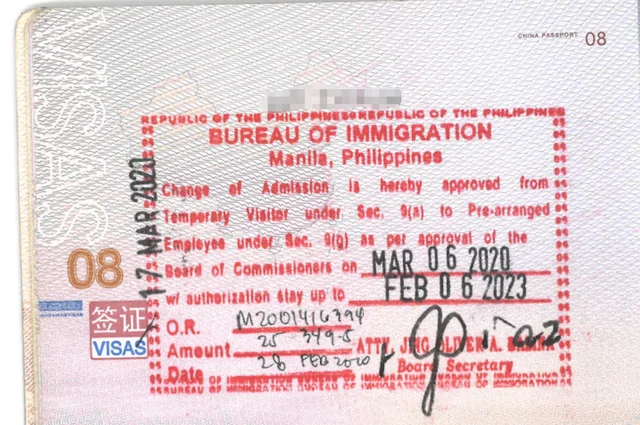
For foreign nationals seeking to build a career in the Philippines, the 9(g) Pre-Arranged Employment Visa is the standard legal requirement. This visa is specifically for foreigners coming to engage in lawful occupations where a legitimate employer-employee relationship exists.
Securing a 9(g) visa is a multi-agency process. The sponsoring employer must first obtain an Alien Employment Permit (AEP) from the Department of Labor and Employment (DOLE), proving that no qualified Filipino citizen is available to perform the job. Once the AEP is approved, the employer petitions the BI for the 9(g) visa, which is typically valid for one, two, or three years, mirroring the employment contract. Holders of the 9(g) visa must participate in the BI’s Annual Report every January-March and must downgrade their visa to a 9(a) status if their employment is terminated.
Other Notable Non-Immigrant Visas (9D, 9E, 9F)
Beyond tourism and standard employment, the Section 9 non-immigrant category accommodates several other specific purposes, ensuring that diplomats, students, and treaty investors have appropriate legal standing.
- 9(d) Treaty Trader/Investor Visa: Available exclusively to nationals of countries that share a treaty of commerce and navigation with the Philippines (such as the USA, Japan, and Germany). It requires substantial trade or investment between the two nations.
- 9(e) Diplomatic Visa: Issued to accredited officials of foreign governments, their families, and staff, providing diplomatic immunity and streamlined entry procedures.
- 9(f) Student Visa: Mandatory for foreign nationals over the age of 15 who are enrolling in a BI-accredited university or college for higher education. This visa requires proof of sufficient financial means to support the student’s education and stay.
Immigrant Visas: Non-Quota Spousal Visas (13A)
Foreign nationals married to Filipino citizens have a direct pathway to permanent residency through the 13(A) Non-Quota Immigrant Visa. This visa acknowledges the importance of family reunification and provides robust residency rights without the need for financial deposits or continuous employment sponsorship.
The application requires a Philippine Statistics Authority (PSA) authenticated marriage certificate, joint affidavits, and comprehensive background clearances. The BI typically issues a one-year probationary visa first, which must be converted into a permanent 13(A) visa before it expires. Holders enjoy an indefinite stay, exemption from the DOLE AEP requirement (though an AEP exemption certificate is needed to work), and the privilege to import household goods duty-free upon their initial relocation.
Immigrant Visas: The Section 13 Quota Visa
The Section 13 Quota Visa is the most exclusive permanent resident visa offered by the Philippine government, capped at an absolute maximum of 50 approvals per nationality per calendar year. It is designed for highly skilled professionals, renowned experts, or independently wealthy individuals from countries with reciprocal immigration agreements.
Because of the strict numerical limit, the application process is highly competitive and heavily scrutinized by the BI Commissioner. Applicants must demonstrate exceptional qualifications, significant capital investment, or extraordinary professional achievements that clearly benefit the Philippine national interest. Successful applicants gain true permanent residency, eliminating the need for recurring visa extensions and offering maximum stability for long-term integration.
Special Resident Retiree’s Visa (SRRV)
The Special Resident Retiree’s Visa (SRRV) is a highly popular special non-immigrant visa managed by the Philippine Retirement Authority (PRA), designed to attract foreign retirees and former Filipinos. It functions as a flexible alternative to permanent residency, granting indefinite stay privileges based on age and financial capacity.
To qualify in 2026, most applicants must be at least 50 years old and place a requisite time deposit in a PRA-accredited bank. The deposit ranges from USD 10,000 (for those with an approved lifetime pension) to USD 50,000, depending on the chosen category (such as SRRV Classic or Smile). A major advantage of the SRRV Classic is the ability to convert the time deposit into active real estate investments, such as purchasing a condominium. SRRV holders enjoy multiple-entry privileges and are exempt from the BI Annual Report and travel tax (for stays under one year).
Special Investor’s Resident Visa (SIRV)
For active investors and entrepreneurs seeking long-term residency, the Special Investor’s Resident Visa (SIRV) provides a targeted pathway. Administered by the Board of Investments (BOI), this visa is available to any foreign national over 21 years of age who commits substantial capital to the Philippine economy.
The SIRV requires a minimum inward remittance of USD 75,000. Within a 180-day probationary period, this initial deposit must be actively invested in eligible vehicles, such as publicly listed companies on the Philippine Stock Exchange (PSE) or BOI-registered manufacturing and service enterprises. As long as the investment remains intact and compliant with BOI rules, the principal investor, their spouse, and unmarried children under 21 retain their indefinite residency status.
Specialized Corporate and Regional Visas (PEZA, ROHQ)
The Philippines offers specific visa categories to support its robust Business Process Outsourcing (BPO) sector and to attract the regional headquarters of multinational corporations. These visas offer streamlined processing for corporate executives and specialized personnel.
- 47(a)(2) PEZA Visa: Issued to foreign employees working for companies registered with the Philippine Economic Zone Authority (PEZA) or the Board of Investments. It typically features faster processing times and fewer BI administrative hurdles compared to the standard 9(g) visa.
- ROHQ / RHQ Visas (under R.A. 8756): Executives working in the Regional Operating Headquarters or Regional Headquarters of multinational companies benefit from this special visa, which provides multiple-entry privileges and favorable tax treatments to encourage corporate centralization in Metro Manila.
Needed Documentation: Apostilles and Clearances
Regardless of which visa category you pursue, the Bureau of Immigration, DOLE, PRA, and BOI maintain strict evidentiary standards for foreign-sourced documents in 2026. Failure to prepare these documents correctly is the leading cause of visa delays and rejections.
Any official document issued outside the Philippines—such as birth certificates, marriage certificates, police clearances, and corporate registrations—must be Apostilled by the issuing country’s competent authority. If the issuing country is not a member of the Apostille Convention, the documents must be authenticated or consularized by the Philippine Embassy or Consulate having jurisdiction over that area. Furthermore, almost all long-term visas require a comprehensive medical examination and a National Bureau of Investigation (NBI) clearance if the applicant has already stayed in the Philippines for an extended period.
Annual Reporting and ACR I-Card Compliance
Securing a visa is only the first part of your legal journey; maintaining it requires ongoing compliance with BI regulations. Almost all foreign nationals holding immigrant and non-immigrant visas (with the exception of some Special Visas like the SRRV) are subject to two strict tracking mechanisms.
First, foreign nationals staying beyond 59 days must secure an Alien Certificate of Registration Identity Card (ACR I-Card), a microchip-enabled ID that serves as proof of legal registration. Second, all ACR I-Card holders must participate in the mandatory Annual Report within the first 60 days of every calendar year (January 1 to March 1). Failure to appear for the Annual Report or failing to renew an expired ACR I-Card results in compounding monthly fines and can lead to the denial of future visa renewals or exit clearances.
Final Thoughts
The Philippine immigration system provides a diverse portfolio of visas for foreign nationals, structured to accommodate short-term tourists, corporate expatriates, long-term investors, and retirees. Success in 2026 relies on selecting the precise category for your intent—whether it is the 9(g) work visa for DOLE-approved employment, the 13(A) immigrant visa for spouses of Filipinos, or specialized asset-based pathways like the SRRV and SIRV for independent residency. Regardless of the path, rigorous compliance with Bureau of Immigration mandates, such as securing properly apostilled international documents, maintaining a valid ACR I-Card, and fulfilling the mandatory Annual Report, is essential to avoiding heavy fines or deportation.
How Work Visa Philippines Can Assist
Work Visa Philippines eliminates the guesswork from your relocation strategy. Our experts manage the entire lifecycle of your Philippine residency, from processing initial 9(a) tourist waivers to securing complex AEP corporate sponsorships, BOI investor approvals, and PRA retirement deposits. We ensure your document kits are flawless and your status remains legally bulletproof year after year.
Don’t risk your stay on a technicality—secure the right visa today. Contact Work Visa Philippines for a comprehensive immigration assessment:
- Contact Us Here
- Fill Out the Form Below
- Call us at +63 (02) 8540-9623