Foreign nationals from treaty partner countries seeking to develop substantial trade or investment between their home country and the Philippines have a powerful immigration tool at their disposal: the Treaty Trader Visa (9D). This specialized non-immigrant visa enables eligible nationals to legally enter, reside, and actively manage enterprises involving significant cross-border commerce, making it ideal for executives, investors, and key personnel directing bilateral business operations.
Legal Basis and Purpose of the Treaty Trader Visa
The 9D Treaty Trader/Investor Visa derives from Section 9(d) of the Philippine Immigration Act of 1940 and bilateral treaties of commerce and navigation between the Philippines and select countries. It serves dual purposes:
Treaty Trader Category
Authorizes nationals to carry on substantial trade principally between the Philippines and their treaty country, where “trade” encompasses commerce beyond mere buying/selling—requiring ongoing business relationships, contracts, and volume.
Treaty Investor Category
Permits direction and development of enterprises involving substantial capital investment (typically USD 120,000+), where the foreign national plays an executive, managerial, or essential supervisory role.
Both categories support spouses and unmarried children under 21 as dependents, making it attractive for business families establishing Philippine operations.
Eligible Countries and Treaty Partners
Only nationals of countries maintaining existing treaties of commerce and navigation with the Philippines qualify:
- United States (Treaty of Amity and Commerce, 1955)
- Japan (Treaty of Commerce, Navigation and Reciprocity, 1973)
- Germany (Treaty of Friendship, Commerce and Navigation, 1974)
Applicants must use their treaty-country passport and demonstrate nationality from one of these countries. Dual nationals typically use their qualifying passport as their primary identification. Other nationalities must pursue standard work visas, like a 9(G) Employment Visa or an investor visa (SIRV).
Who Qualifies? Detailed Eligibility Criteria
Principal Applicant Requirements
Treaty Trader:
- National of the US/Japan/Germany
- Engaged in substantial trade (not isolated transactions) principally between the Philippines and the treaty country
- Trade must be ongoing/continuous with evidence of volume, contracts, and business relationships
Treaty Investor:
- National of the US/Japan/Germany
- Substantial investment (≥USD 120,000) at risk in a Philippine enterprise
- Applicant must develop and direct the enterprise (executive/managerial/supervisory role)
- Investment must be an active, not a passive portfolio holding
Common Eligible Roles
- Corporate executives developing bilateral trade
- Regional managers overseeing treaty-country supply chains
- Technical directors establishing manufacturing/assembly for export/import
- Investment managers directing qualifying capital deployment
Dependent Eligibility
- Legally wedded spouse
- Unmarried children under 21 years old
- Must accompany or join the principal applicant
Non-qualifying activities include local retail, simple import/export brokerage, or investments below substantial thresholds.
Complete Documentary Requirements
Here is the list of documents that a foreign national needs:
Principal Applicant Documents
- Checklist of complete requirements
- Consolidated General Application Form (CGAF) – BI Form CGAF-002-Rev 3
- Letter-request from petitioning company to BI Commissioner detailing trade/investment
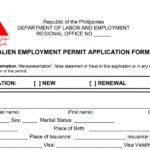
- Alien Employment Permit (AEP) from DOLE (mandatory prerequisite)
- Passport photocopy (bio-page + latest admission with valid stay)
- Employment documents
- Notarized employment contract
- Secretary’s Certificate of election/appointment/secondment
- Board Resolution authorizing position
- Business documents
- SEC/DTI Certificate of Registration
- Latest Mayor’s Permit
- Latest Audited Financial Statements
- Latest ITR with payment proof
- Proof of substantial trade/investment
- Trade: Invoices, contracts, shipping docs showing volume ≥USD 120K
- Investment: Bank certificates, remittances, business plans, capitalization docs
- BI Clearance Certificate (issued within 6 months)
- Curriculum Vitae and Organizational Chart showing the applicant’s role
- Medical Certificate from the Bureau of Quarantine (if applicable)
Petitioner/Company Documents
- SEC Articles of Incorporation & By-Laws
- Latest General Information Sheet (GIS)
- Latest Audited Financial Statements
- Tax Clearance Certificates
- Proof of inward remittance for foreign capital
Dependent Documents
- Marriage Certificate (apostilled/authenticated if foreign)
- Birth Certificates (apostilled/authenticated if foreign)
- Passports and BI records
All foreign documents require a DFA apostille or embassy authentication.
Step-by-Step Application Process
Securing a Treaty Trader Visa (9D) follows a structured sequence beginning with the Alien Employment Permit (AEP) from DOLE, followed by a comprehensive submission to the Bureau of Immigration (BI) involving pre-screening, hearings, biometrics, and final implementation.
Phase 1: Pre-Application (DOLE AEP)
- Employer files AEP application with DOLE Regional Office
- Publish the job vacancy for 15 days to allow Filipino objections
- DOLE issues AEP (2-3 weeks processing)
Phase 2: BI Visa Application
- Secure CGAF from the BI Public Information Unit
- Submit complete docs to the Central Receiving Unit (CRU)
- Receive Order of Payment Slip (OPS)
- Pay fees at an authorized bank
- Submit the Official Receipt copy
- Pre-screening approval leads to hearing scheduling
- Attend Motion Hearing before the BI Legal Division
- Biometrics (photo/fingerprints) at Alien Registration Division
- Visa Implementation – submit passport for stamping
- Receive an ACR I-Card confirming status
Processing Time: 1-3 months total
Extensions (Annual)
Follow the same process 60 days before expiry, proving continuing substantial trade/investment.
Benefits and Privileges
- Work authorization without annual quotas
- Family inclusion (spouse + children <21)
- Multiple entry privileges
- Renewable indefinite duration tied to business viability
- Access to economic zones and investment incentives
- Pathway for executive transfers and regional HQs
Supports genuine treaty-based commerce, not local retail/service businesses.
Renewal and Compliance Obligations
Annual renewals require:
- Updated trade volume documentation (≥USD 120K/year)
- Current AEP validity
- Company tax compliance (BIR Certificate of Registration, clearances)
- No derogatory BI records
- Continuing executive role proof
Non-compliance risks:
- Visa cancellation
- Blacklisting from future applications
- Deportation proceedings
Dependents renew with the principal.
Common Challenges and Solutions
- Proving “substantiality”: Document trade ≥USD 120K with contracts/invoices/bank records.
- AEP delays: Start DOLE process 2 months early.
- Dependent docs: Apostilled foreign marriage/birth certificates.
- Nationality proof: Submit a treaty-country passport and birth certificate.
- Business viability: Show ongoing operations, not one-off deals.
Pro Tip: Engage immigration counsel experienced in 9D cases.
Comparison: 9D vs Other Business Visas
Understanding how the Treaty Trader Visa (9D) compares to other Philippine business visas helps foreign nationals select the most appropriate immigration pathway for their specific objectives and nationality.
The 9D Treaty Trader Visa stands out for its exclusive eligibility for nationals of the US, Japan, and Germany, requiring proof of substantial trade (≥ USD 120,000 annually) or investment under executive direction, while permitting family inclusion for spouses and children under 21.
In contrast, the 9G Employment Visa serves all nationalities for regular long-term employment with Philippine companies. Still, it demands an Alien Employment Permit (AEP) from DOLE and lacks automatic family provisions, focusing instead on specific job contracts rather than treaty-based commerce.
The Special Investor’s Resident Visa (SIRV) opens to all nationalities with a lower USD 75,000 investment threshold in approved sectors, offering indefinite residency tied to active investment maintenance and explicitly allowing family accompaniment, though without the treaty trade focus of the 9D.
Meanwhile, the 9A Temporary Visitor Visa (including 9(a-1) business subcategory) accommodates all nationalities for short-term activities like meetings or conferences but prohibits employment or revenue generation, requires no minimum investment, and excludes family visas, making it unsuitable for ongoing business operations.
Key differentiators include:
- Nationality restrictions: 9D limited to treaty countries vs. open access for 9G/SIRV/9A
- Investment thresholds: 9D (USD 120K trade/investment) vs. SIRV (USD 75K) vs. none for 9G/9A
- Work authorization: Full executive rights (9D/9G) vs. investment-based (SIRV) vs. meetings only (9A)
- Family benefits: Included (9D/SIRV) vs. limited/additional process (9G) vs. none (9A)
- Renewal basis: Ongoing trade proof (9D) vs. employment continuity (9G) vs. investment maintenance (SIRV) vs. short extensions (9A)
Key Takeaways
The Treaty Trader Visa (9D) provides US, Japanese, and German nationals a strategic immigration pathway to develop substantial bilateral commerce in the Philippines. With proper documentation proving ongoing trade volume or qualifying investment under executive direction, applicants secure renewable residence supporting business growth in Southeast Asia’s fastest-growing economy.
Need Treaty Trader Visa Assistance?
Work Visa Philippines specializes in 9D applications for treaty nationals:
- AEP procurement and DOLE coordination
- Complete BI documentation and hearing representation
- Annual renewals and compliance monitoring
- Dependent visa processing
Contact us today for an initial consultation:
- Contact Us Here
- Fill Out the Form Below
- Call us at +63 (02) 8540-9623