Alien Employment Permit (AEP) application mistakes in the Philippines are the leading cause of delays, denials, and compliance issues for employers and foreign workers applying for Alien Employment Permits. Incomplete documents, skipped job postings, and late filings result in rejections or extra weeks of processing, often derailing 9(g) work visa timelines. This comprehensive guide covers the top 10 AEP application mistakes, detailed avoidance strategies, and best practices based on DOLE guidelines and common rejection grounds from Department Order 248.
Why AEP Applications Get Rejected So Often
AEP application mistakes account for 30-50% of DOLE rejections, primarily due to the misinterpretation of Department Order 248 requirements, such as labor market tests and skills transfer plans. Employers often underestimate the importance of 15-30 day job postings or understudy documentation, which can lead to automatic denials. Fraud, misrepresentation, or visa non-compliance grounds immediate rejection or post-approval revocation. Awareness of these pitfalls enables 90%+ first-pass success, saving 2-4 weeks and PHP 10,000+ fines for unauthorized work.
Mistake #1: Submitting Incomplete or Incorrect Documentation
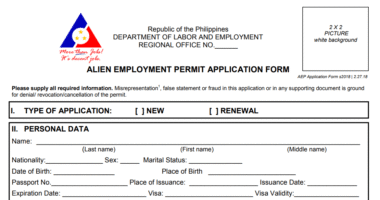
The most frequent AEP application mistake is incomplete or erroneous paperwork, which can result in outright rejection or return for corrections. Missing AEP forms, unsigned contracts, or incorrect photo specifications halt processing until the documents are resubmitted.
To avoid:
- Follow the DOLE checklists exactly: AEP form, contract, copies of passport/visa, and a 2×2 photo.
- Verify contract matches position/salary in posting.
- Scan/notarize all before filing; use digital AEMS where available.
This mistake adds 2-4 weeks; double-check submissions.
Mistake #2: Missing or Improper Job Posting Requirement
DOLE mandates 15-30 day vacancy publication; skipping it is a top AEP application mistake leading to denial. No certificate of publication means no proof of local hiring efforts.
To avoid:
- Post on PhilJobNet and the newspaper of general circulation 15 or more days before filing.
- Attach the full publication certificate and the applicant summary.
- Document no qualified Filipinos explicitly.
Publication failure is fatal; plan 30 days early.
Mistake #3: Applying Too Late Before Work Starts
Filing an AEP application close to the start date ignores the 2-3 week processing, forcing illegal work or delays, which is a common AEP application mistake.
To avoid:
- Submit 1+ months before needed.
- No work until AEP is issued; use Provisional Work Permit interim.
- Align with 9(g) timelines.
This prevents fines/deportation.
Mistake #4: Selecting the Wrong Permit Type
Confusing AEP (long-term) with SWP (short-term) is a frequent AEP application mistake. The wrong type leads to denial or rework.
To avoid:
- AEP for 1+ year roles + 9(g).
- SWP for projects <6 months.
- Assess duration upfront.
Ensure that it aligns with job requirements.
Mistake #5: Ignoring Visa Synchronization
AEP alone doesn’t allow stay/work; AEP application mistakes forget 9(g) visa follow-up. Tourist status is insufficient in the long term.
To avoid:
- File 9(g) at BI after AEP.
- Coordinate employer/employee docs.
- Provisional for bridge.
Full compliance requires both.
Mistake #6: Weak Evidence of No Local Workers
DOLE demands proof that no Filipino qualifies; vague evidence causes AEP application mistakes and denials.
To avoid:
- Include interview logs and CV evaluations of locals.
- Post with precise qualifications.
- Certify unavailability explicitly.
Meritorious objections kill applications.
Mistake #7: Late or Forgotten Renewals
AEP application mistakes include renewal lapses, and starting violations on day 1 post-expiry.
To avoid:
- Renew 60 days early; track expiries.
- Prep updated docs.
- Align with visa renewals.
These strategies avoid bans/fines.
Mistake #8: Not Reporting Job/Employer Changes
AEP is specific; changes without amendment/amended AEP are an AEP application mistake.
To avoid:
- Notify DOLE immediately; file an amendment/new.
- For transfers, new AEP.
- Update within 15 days.
Keep everything valid.
Mistake #9: Fee Calculation or Payment Errors
Incorrect AEP application fees (PHP 9k first year, 4k after) cause rejections.
To avoid:
- Calculate by validity (PHP 9k/yr first).
- Pay at the correct DOLE office; retain OR.
- Confirm current rates.
No refunds.
Mistake #10: One AEP for Multiple Jobs/Employers
AEP application mistakes assume one permit covers all; it’s job/employer-specific.
To avoid:
- Separate AEP per role/company.
- New for transfers/add-ons.
- Limit to one primary.
Comply precisely.
Additional Pitfalls: Fraud and Misrepresentation
Beyond the top 10, AEP application mistakes include falsified documents or facts, grounds for denial/revocation, and bans.
Avoid absolute honesty; apostille all foreign docs.
Best Practices for Flawless Applications
Implementing structured protocols effectively obviates AEP application mistakes, consistently attaining first-pass success rates exceeding ninety percent (90%). These methodologies encompass systematic pre-submission audits, temporal orchestration synchronized with 9(g) visa imperatives, and perpetual surveillance via digital interfaces.
Prescribed modalities include:
- Rigorous conformity to Department of Labor and Employment checklists antecedent to lodgment, effectuating comprehensive pre-submission probity audits.
- Institution of sixty (60)-day antecedence protocols, augmented by Provisional Work Permit preparedness as contingency.
- Exploitation of Alien Employment Management System perpetual surveillance; delegation to accredited intermediaries for Regional Office attendances.
- Institution of annual compliance probity audits antecedent to positional or employer transmutations.
- Engagement of specialized consultancies for adjudicative prognostication and derogation preclusion.
Final Insights
AEP application mistakes like incomplete documentation, skipped job postings, late filings, and unreported changes consistently cause rejections, processing delays of 2-4 weeks, and compliance penalties, including PHP 10,000 fines per violation. These errors not only disrupt hiring timelines but also risk deportation proceedings for foreign workers and employer blacklisting by DOLE, potentially derailing 9(g) work visa processes that depend on valid AEP authorization. Prevention through systematic checklists, 60-day early filing, and pre-submission audits eliminates 90% of common pitfalls, ensuring first-pass approvals and seamless integration with Bureau of Immigration requirements.
Is Assistance Available?
Yes. Work Visa Philippines eliminates AEP application mistakes through comprehensive DOLE expertise, document audits, and coordination of Provisional Work Permits, ensuring full synchronization with 9(g) visa timelines for uninterrupted 2026 compliance. By handling everything from PhilJobNet postings to understudy plan validation, employers avoid costly rework while foreign nationals maintain continuous legal work status without gaps or penalties.
Contact our team of specialists for expert guidance:
- Contact Us Here
- Fill Out the Form Below
- Call us at +63 (02) 8540-9623