Foreign nationals seeking employment in the Philippines must secure both an Alien Employment Permit (AEP) from the Department of Labor and Employment (DOLE) and an appropriate work visa from the Bureau of Immigration (BI). These dual requirements ensure compliance with labor market tests, protect local employment opportunities, and authorize legal work under specific employer sponsorship.
The Alien Employment Permit (AEP): Mandatory Prerequisite
Before any work visa can be issued, nearly all foreign nationals must obtain an Alien Employment Permit (AEP) from DOLE, certifying that no qualified Filipino worker is available for the position. This permit serves as the foundational legal document authorizing employment in the Philippines.
Key AEP Requirements
- Completed DOLE application form
- A photocopy of passport with valid visa
- Employment contract and related documents
- Photocopy of current AEP (for renewals/reissues)
- Employer’s Mayor’s Permit or Business Permit
AEP Exemptions
Certain categories bypass AEP requirements:
- Diplomatic personnel and foreign government officials
- Owners/representatives of POEA-accredited foreign firms
- Permanent residents and certain temporary resident visa holders
- Foreigners working for overseas employers (no local employment relationship)
The AEP validity aligns with employment contracts (typically 1-3 years) and must remain current throughout the work visa period.
9(G) Pre-Arranged Employment Visa: The Standard Work Visa
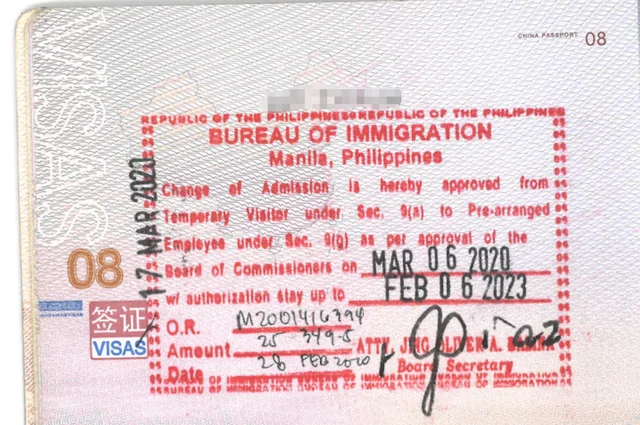
The 9(G) Pre-Arranged Employment Visa is the most common work authorization for foreign professionals employed by Philippine companies in roles requiring specialized skills unavailable locally. Employer-sponsored and AEP-dependent, it binds the worker to their sponsoring entity.
9(G) Visa Features
- Initial validity: 1, 2, or 3 years (matches employment contract)
- Renewable in 3-year increments
- Cannot exceed the AEP validity period
- Downgrades to tourist status upon employer change (requires new application)
Comprehensive 9(G) Requirements
- Notarized certification of foreign vs. Filipino employee ratios
- BI Form No. 2 (application form)
- Medical examination (FA Form No. 11) from an authorized physician
- Notarized employment contract
- 4 passport-sized photos
- Police clearance from home country
- SEC certification and Articles of Incorporation (employer)
- Certified true copy of AEP
- BI Clearance Certificate
- Alien Certificate of Registration (ACR I-Card)
- Valid passport
- Additional supporting employment documents
Processing involves the employer petitioning BI after AEP approval, with hearings and biometrics required.
Treaty Trader Visa (9D): For Bilateral Commerce Partners
The 9(D) Treaty Trader Visa serves nationals of countries with commerce treaties (US, Japan, Germany), authorizing substantial trade or investment activities principally between the Philippines and the treaty country.
9(D) Eligibility Criteria
- Prove substantial trade (≥US$120,000 annually) or investment
- Intent to depart upon contract completion
- Same nationality as the employer/principal shareholder
- Executive/supervisory position
Valid up to 2 years and renewable with proof of continuing treaty-based commerce. Non-treaty nationals pursue standard 9(G) or investor visas.
Alternative Long-Term Residency Options for Investors
Foreign investors bypassing traditional work visas can access special resident visas tied to economic contributions:
Special Investor’s Resident Visa (SIRV)
- Minimum investment: US$75,000 in approved sectors
- Grants indefinite residency (renewable)
- No employment restrictions within the investment enterprise
Special Resident Retiree’s Visa (SRRV)
- For investors ≥35 years old
- Requires deposit starting at US$1,500-US$20,000 (age-dependent)
- Indefinite multiple-entry privileges
- Limited work rights; primarily residency-focused
Both support family inclusion and offer pathways for business owners avoiding AEP/9(G) requirements.
Application Process for Work Visas
Securing work visas follows a structured sequence involving DOLE and BI coordination, typically spanning 2-4 months from start to ACR I-Card issuance.
Step 1: Secure AEP (DOLE)
- Employer publishes job vacancy (15 days)
- Submit complete application to the DOLE Regional Office
- Receive AEP approval (2-4 weeks)
Step 2: Employer Petitions BI
- File 9(G) application with complete documentation
- BI pre-screening and Order of Payment
- Motion hearing before Legal Division
- Biometrics and visa implementation
Step 3: Receive Authorizations
- Visa stamped in passport
- ACR I-Card issued (confirms status)
- Annual reporting obligations commence
Extensions filed 60 days pre-expiry with updated AEP and employment proof.
Employer Responsibilities and Compliance
Philippine employers bear significant obligations when hiring foreigners:
Labor Market Test
- Prove no qualified Filipino available via job posting/advertising
- Justify specialized skills/qualifications
Mandatory Registrations
Register foreign employees with:
- Social Security System (SSS): Employer contributes up to PHP 1,600/month
- PhilHealth: Employer max PHP 900/month; employee PHP 150-900
- Pag-IBIG Fund: Employer/employee up to PHP 100 each (foreigners exempt from HDMF in some cases)
Ongoing Compliance
- Monthly/quarterly tax withholdings and remittances
- Annual AEP/visa renewals
- Employment reports to DOLE/BI
Non-compliance risks fines, AEP revocation, and deportation orders.
Social Security Contributions Breakdown
Mandatory social security contributions in the Philippines protect foreign workers under three key programs administered by SSS, PhilHealth, and Pag-IBIG, with employers bearing primary responsibility for registration and remittance.
- Social Security System (SSS): Effective January 2025, the total contribution rate increased to 15% of Monthly Salary Credit (MSC) up to PHP 35,000 (employer 10%, employee 5%), with a minimum MSC at PHP 5,000, yielding employer contributions up to PHP 3,500/month for maximum earners, plus 3% penalties on late payments.
- PhilHealth: Employers contribute up to PHP 900/month while employees pay PHP 150-900 based on salary brackets, providing universal healthcare coverage essential for expat medical needs.
- Pag-IBIG Fund (HDMF): Both employer and employee contribute up to PHP 100/month each (total PHP 200), though foreign nationals are often exempt from HDMF requirements, reducing their personal burden.
These contributions—totaling over PHP 2,600/month per high-salary foreign employee from the employer side—must be remitted monthly, with employers handling withholding, filing, and compliance to avoid penalties while ensuring workers access benefits like pensions, healthcare, and housing loans.
Change of Employer and Visa Implications
Critical Rule: 9(G) visas are employer-specific. Changing employers triggers:
- Immediate downgrade to 9(A) tourist status
- New AEP application with current employer
- Fresh 9(G) petition to BI
- Potential work gap during processing (2-3 months)
Strategic planning, such as securing a new AEP before resignation, minimizes disruptions. Treaty (9D) and investor visas offer more flexibility.
Common Challenges and Solutions
Foreign workers and employers frequently encounter:
- AEP delays due to labor market objections: Start 3 months early.
- Document authentication: Apostille foreign police clearances/employment records.
- Employer ratio certification: Maintain accurate foreign/Filipino headcount records.
- Medical exam timing: Schedule post-arrival with BI-authorized physicians.
- ACR I-Card renewals: File annually regardless of visa validity.
Professional immigration support prevents costly compliance failures.
Key Takeaways
Navigating work visas in the Philippines requires coordinated AEP and BI approvals, employer sponsorship, and ongoing social security compliance. The 9(G) serves most professionals, while treaty nationals access 9(D), and investors pursue SIRV/SRRV alternatives. Proper planning ensures seamless legal employment supporting career growth in the Philippines’ dynamic economy.
Need Work Visa Assistance in the Philippines?
Work Visa Philippines guides foreign professionals through AEP procurement, 9(G)/9(D) applications, renewals, and compliance:
- Complete documentation preparation
- DOLE/BI representation
- Social security registrations
- Employer change support
Contact us today for an initial consultation:
- Contact Us Here
- Fill Out the Form Below
- Call us at +63 (02) 8540-9623