Renewing a 9(g) Pre-Arranged Employment Visa in the Philippines is a two-stage regulatory process that requires foreign professionals to first obtain a renewed Alien Employment Permit (AEP) from the Department of Labor and Employment (DOLE) followed by a visa extension from the Bureau of Immigration (BI), with a recommended 90-day lead time to navigate labor market testing and agency hearings.
Under the latest 9G visa renewal guidelines, applicants must demonstrate continuing employment with the same sponsoring entity, submit updated employer corporate credentials, and adhere to strict 2026 OAPS digital filing mandates to avoid daily overstay penalties of PHP 500 and possible deportation. The renewal process typically takes 4-8 weeks for the AEP and 2–4 weeks for the visa, with costs ranging from PHP 25,000 to PHP 45,000 depending on the validity period and use of express services.
Understanding the Dual-Agency Renewal Workflow
The 9G visa renewal is not a single transaction but a sequential coordination between DOLE and the BI, where the validity of the work visa is strictly dependent on the underlying labor permit. Foreign professionals must ensure their AEP is renewed before their current visa expires, as the BI will not entertain a renewal petition without a certified copy of the updated AEP from DOLE.
The renewal workflow follows this mandatory sequence:
- AEP Renewal (DOLE): Filed at least 30 to 60 days before the current AEP expires to allow for the mandatory 30-day labor market publication and objection period.
- 9(g) Visa Renewal (BI): Filed at least one month before the current visa expires, once the AEP card or DOLE’s proof of renewal is secured.
- ACR I-Card Renewal (BI): Processed alongside the visa extension to issue a new microchip-embedded ID card with updated validity.
Lapsing on the AEP renewal effectively halts the visa extension, leading to a downgrade in status or administrative fines. Proactive synchronization of these two agencies is the core of a successful renewal strategy.
Prerequisite: Renewing the Alien Employment Permit (AEP)
As the primary prerequisite for a 9G visa renewal, the AEP renewal must prove to DOLE that the foreign national’s continued employment remains necessary and that no qualified Filipino is available for the role through a fresh Labor Market Test (LMT). Failure to initiate this 30-60 days before expiration is a common cause of visa lapses.
Core requirements for AEP renewal:
- Duly accomplished AEP renewal form: Signed by the foreign employee and the employer’s authorized representative.
- Original AEP card: Surrendered for the issuance of the new card.
- Updated Employment Contract: Specifying the renewed term, salary, and job description (must match the original or be formally amended).
- Employer Corporate Credentials: Valid Mayor’s Permit, current SEC General Information Sheet (GIS), and Tax Clearance.
- Newspaper Clipping: Proof of the renewal notice’s publication in a newspaper of general circulation (standard DOLE requirement).
Fees for AEP renewal are approximately PHP 9,000 for one year, plus PHP 4,000 for every additional year of validity requested.
Required Documentation for 9(g) Visa Extension
Once the AEP is secured, the applicant must file the 9G visa renewal petition at the BI Main Office in Intramuros or at an authorized field office, providing a comprehensive set of documents that verify their immigration history and the employer’s standing. The 2026 guidelines emphasize digital consistency through the OAPS portal.
The standard documentation package includes:
- Consolidated General Application Form (CGAF): The primary BI form (MCL-07-01) for non-immigrant visa extensions.
- Letter Request from the Sponsoring Employer: Addressed to the BI Commissioner, reaffirming the need for the foreign professional.
- Certified True Copy of the Renewed AEP: The vital link between DOLE and BI.
- Passport (Original and Photocopies): Including the bio-data page, the current 9(g) visa stamp, and the latest arrival stamp.
- Current ACR I-Card: To be surrendered for replacement.
- BI Clearance Certificate: To prove no derogatory records or pending cases in the Philippines.
Ensuring that job titles and salary figures are consistent across the AEP, contract, and CGAF is critical to avoiding technical denials.
Step-by-Step 9G Visa Renewal Process
The 9G visa renewal process involves several administrative checkpoints, from initial pre-screening to final passport restamping, and typically requires the applicant’s physical presence for biometric capture.
- Pre-Screening: Submit the documentary package at the BI Central Receiving Unit (CRU) for a preliminary check of completeness.
- Fee Payment: Pay the visa extension and ACR I-Card fees at the Cashier Section and secure the Official Receipt.
- Motion for Hearing: Attend a brief hearing or evaluation at the BI Legal Division if required for the specific visa category.
- Biometrics Capture: Visit the Alien Registration Division (ARD) for fingerprinting and photo capturing for the new ACR I-Card.
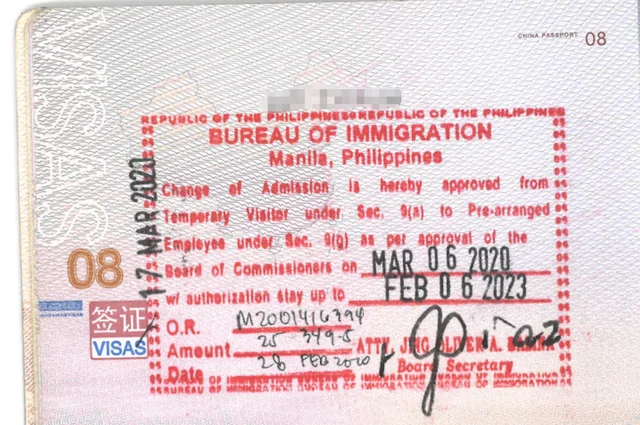
- Approval and Implementation: Wait for the BI Board of Commissioners to approve the petition; once approved, the new visa is stamped on in the passport.
- I-Card Issuance: Claim the renewed ACR I-Card once notified by the BI portal.
The entire BI phase usually spans 2-4 weeks, provided there are no derogatory findings or missing documents.
Costs and Fee Structure for Renewal
Budgeting for a 9G visa renewal requires accounting for both DOLE and BI fees, which vary based on the requested duration (typically 1, 2, or 3 years) and the applicant’s status as a principal or dependent.
| Expense Category | Estimated Fee (PHP) | Notes |
| AEP Renewal Fee | 9,000 – 17,000 | PHP 9k (1yr) + PHP 4k per extra year |
| Visa Extension | 8,620 – 19,000 | Varies by duration and express fees |
| ACR I-Card | 2,800 | Approximately USD 50 |
| BI Clearance | 1,000 – 1,500 | Standard clearance fee |
| Total Estimate | 25,000 – 45,000 | Excluding agency or legal fees |
Late filing of the AEP carries a heavy penalty of PHP 1,000 per day of delay, underscoring the importance of meeting the 30-day lead time.
Common Mistakes and Pro Tips for Success
Navigating a 9G visa renewal can be challenging due to clerical inconsistencies or missed administrative windows, but following a structured approach can mitigate these risks and ensure a seamless extension.
Common mistakes to avoid:
- Failing to renew the AEP at least 30 days before expiration, leading to daily DOLE fines and visa processing blocks.
- Inconsistencies in job titles or salaries between the renewed AEP and the BI petition, triggering “Request for Evidence” (RFE) or denials.
- Overlooking the need to update the employer’s SEC General Information Sheet (GIS), which must be less than six months old at the time of filing.
- Neglecting to submit the latest Income Tax Return (ITR) or proof of tax compliance, which BI increasingly scrutinizes.
Pro tips for guaranteed success:
- Implement a 90-day renewal calendar: Start AEP prep at Day 90, file AEP at Day 60, and file the BI visa petition at Day 30.
- Use digital repositories to store scanned copies of previous AEPs, implementation letters, and contracts for quick cross-referencing.
- Ensure that the employer’s Mayor’s Permit and Business Permit are valid for the entire duration of the requested renewal.
- Engage BI-accredited consultants to track the status through the OAPS portal and manage administrative hearings efficiently.
Compliance and Post-Renewal Obligations
Once the 9G visa renewal is approved and the new ACR I-Card is issued, the foreign professional has ongoing obligations to maintain their legal status. Failure to comply with these can jeopardize future renewals.
Post-renewal duties:
- Annual Report: Every 9(g) holder must report in person (or virtually) to the BI within the first 60 days of every calendar year (January to March).
- Address Changes: Notify the BI within 30 days of any change in residential address or employment location.
- ACR I-Card Safeguarding: Always carry the original card; loss or damage requires immediate reporting and re-issuance (PHP 2,500+ fee).
- ECC-B for Travel: If planning to leave the country for more than six months, ensure a valid Emigration Clearance Certificate (ECC-B) is obtained before departure.
Adhering to these rules ensures that the foreign professional remains in “good standing” for their next renewal cycle.
Key Takeaways
The 9G visa renewal process in the Philippines is a highly structured, two-agency procedure requiring the successful extension of an Alien Employment Permit from DOLE (4-8 weeks) followed by a 9(g) visa petition at the Bureau of Immigration (2-4 weeks), involving total costs between PHP 25,000 and PHP 45,000 depending on the requested validity of 1 to 3 years.
To ensure an uninterrupted stay and avoid daily overstay penalties of PHP 500 or DOLE late fees of PHP 1,000 per day, foreign professionals must initiate their renewal calendar at least 90 days before expiration, ensuring that job titles, salaries, and employer credentials—including a current SEC General Information Sheet—are consistent across all digital OAPS and physical filings. Failure to synchronize these renewals can result in technical denials, status downgrading, or deportation, making proactive compliance and professional guidance essential for expatriates in BPO, IT, and executive roles.
Is Assistance Available?
Yes. Work Visa Philippines provides end-to-end 9G visa renewal management, including AEP labor market testing coordination, document audits, BI hearing representation, and OAPS status tracking to eliminate procedural risks.
Schedule a consultation today with our team of specialists:
- Contact Us Here
- Fill Out the Form Below
- Call us at +63 (02) 8540-9623