The Department of Labor and Employment (DOLE) significantly tightened and clarified the rules governing Alien Employment Permits (AEPs) in 2026, reshaping how Philippine companies hire and retain foreign professionals. These updates stem from the revised implementing rules on AEP issuance and the economic needs test (ENT) framework, which now emphasize strict labor‑market justification and active skills transfer to Filipino workers. For foreign employers and local HR departments relying on workvisaphilippines.com for compliance support, understanding these DOLE AEP policy shifts is critical to avoid costly rejections, fines, or disruptions to corporate operations.
What Is the Alien Employment Permit (AEP) and Why It Matters
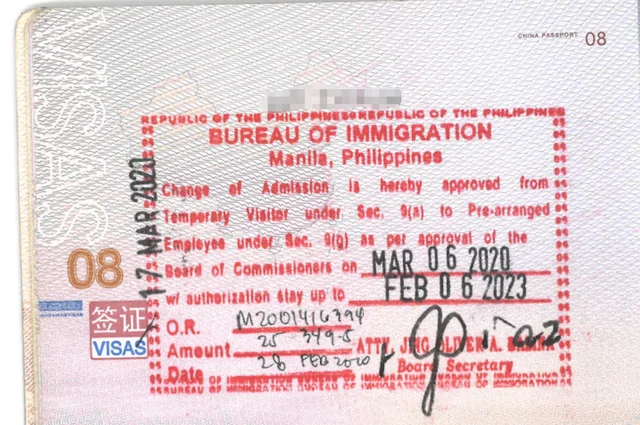
The Alien Employment Permit is a mandatory authorization issued by DOLE that allows a foreign national to legally work for a Philippine‑registered employer. An AEP is not a standalone visa; it is the labor‑market clearance that underpins the foreign worker’s 9(g) Pre‑Arranged Employment Visa and other work‑based immigration statuses. Without a valid AEP, any foreign national working in the Philippines is considered an illegal worker, exposing both the individual and the employer to deportation, fines, and business sanctions.
DOLE evaluates each AEP application based on the Economic Needs Test (ENT), which requires the employer to prove that the proposed role cannot be adequately filled by a qualified Filipino citizen. The AEP thus acts as the primary legal gate through which foreign professionals must pass before engaging in productive employment in the country.
Key 2026 DOLE AEP Policy Changes
In 2026, DOLE’s AEP policies have become more structured, consistent, and compliance‑driven, with several prominent changes affecting foreign employers. The following themes dominate the current regulatory environment:
- Standardized Economic Needs Test (ENT) guidelines: Regional offices now apply a harmonized ENT checklist, reducing ambiguity in decision‑making and requiring employers to demonstrate a documented recruitment history showing local hiring attempts.
- Stricter documentation and transparency: Applicants must provide clear evidence of job‑specific skills, qualifications, and salary structures that justify the foreign hire’s necessity.
- Enhanced skills-transfer requirement (Understudy Training Program or UTP): Employers are expected to design and document a robust UTP that shows how the foreign national will train Filipino understudies to assume the role.
- Uniform processing timelines and electronic tracking: DOLE‑NCR and other regional offices have implemented stricter timelines for AEP processing and release, with clear metrics for employers to monitor their applications online.
These changes aim to protect the Filipino labor market while ensuring that foreign professionals with genuine expertise can still fill critical gaps.
The Economic Needs Test (ENT) in 2026
The Economic Needs Test remains the cornerstone of the AEP application, but the 2026 DOLE AEP policy guidance has refined how it is interpreted and enforced. DOLE now explicitly requires employers to prove that no qualified Filipino is available for the proposed position, using a documented recruitment trail.
To satisfy the ENT, employers must typically:
- Publish the position in local job portals or local newspapers, providing proof of advertising.
- Demonstrate that the interviewed Filipino candidates lacked the precise skills, experience, or language proficiency required.
- Show that the foreign national’s proposed role is critical to the company’s operations or competitiveness, such as specialized technical or executive functions.
Failure to provide this evidence leads to a negative ENT finding, which in turn results in the denial of the AEP and, by extension, the foreign employee’s 9(g) visa petition.
Understudy Training Program (UTP) Requirements
In 2026, DOLE has placed renewed emphasis on the Understudy Training Program as a formal component of the AEP framework, even though it is technically championed by the Bureau of Immigration and PEZA‑linked entities. The UTP is a skills‑transfer plan in which the foreign national trains designated Filipino understudies to assume the foreigner’s role over time.
DOLE’s AEP policy now expects HR and corporate management to submit a detailed UTP that includes:
- The names and positions of the Filipino understudies.
- The training modules, timelines, and performance metrics.
- Evidence of progress reports submitted periodically to DOLE or the BI.
Employers who neglect the UTP, treat it as a perfunctory formality, or fail to submit progress reports may face delays or denials in AEP renewals, as the BI and DOLE coordinate on this requirement.
Salary and Job Specification Policies
The 2026 DOLE AEP policy has also clarified expectations around salary levels and job‑duty definitions to ensure that foreign hires are not used to undercut local wages or obscure the true nature of the role. DOLE expects that the foreign national’s compensation is commensurate with the position’s complexity and the employer’s capacity, rather than artificially low to minimize perceived “local displacement.”
Moreover, the job description must be precise and aligned across the AEP application, the contract of employment, and the 9(g) petition filed with the BI. Any substantial discrepancy—for example, if DOLE approves a “Senior Software Engineer” but the BI sees a “Junior” role—can trigger further scrutiny or denial of the visa.
Documentation and Processing Timeline Expectations
The revised DOLE AEP policy includes more explicit guidance on the documents required for AEP applications and the expected processing timelines, which are now enforced with greater consistency across regional offices.
Standard documentation for an AEP application generally includes:
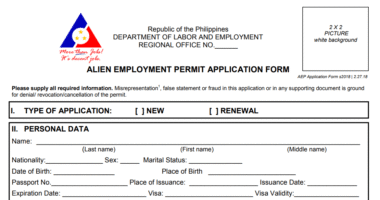
- A duly accomplished AEP application form, signed by the foreign national and the employer’s CEO or authorized officer.
- A notarized employment contract or job offer specifying the term of employment, salary, and job duties.
- Proof of the company’s incorporation and good standing, such as the latest General Information Sheet (GIS) from the Securities and Exchange Commission (SEC).
- For certain categories, additional supporting documents such as training plans or UTP reports, depending on the employer’s industry and accreditation status.
In 2026, DOLE‑NCR has set a target of 15 working days for AEP processing, although the actual time may vary by region and workload. Employers are encouraged to file at least 60 days before the employee’s current AEP or visa expires to avoid overstay or deployment‑delay issues.
Consequences of Non-Compliance with Updated AEP Policies
The updated DOLE AEP policy carries significant consequences for employers and employees who fail to comply with the new requirements. DOLE has reinforced the penalties for hiring without a valid AEP, which include:
- Fines that can reach PHP 10,000 per foreign worker per year (or fraction thereof), levied against both the employer and the employee.
- Suspension or revocation of existing AEPs, which can cascade into BI‑imposed work visa suspensions.
- Risk of deportation and blacklist orders for the foreign national.
Additionally, employers that repeatedly fail the Economic Needs Test or show a pattern of favoring foreign hires over qualified Filipinos may face closer scrutiny from DOLE in future applications and reputational damage.
How Foreign Employers Can Adapt to the 2026 AEP Regime
Foreign employers and their HR teams can adapt to the 2026 DOLE AEP policy through strategic planning and internal governance. Recommended best practices include:
- Implementing a standardized AEP workflow that includes early ENT assessment, documented recruitment history, and preparation of the UTP before formally submitting the AEP.
- Training HR and hiring managers on the DOLE AEP policy updates, including the importance of job description consistency and salary structuring.
- Partnering with immigration consultants such as Work Visa Philippines to ensure that AEP filings are accurate, timely, and aligned with BI requirements for the 9(g) visa.
By aligning corporate hiring practices with the 2026 DOLE AEP policy, employers can secure foreign talent without jeopardizing their legal standing or their Filipino workforce’s rights.
Final Thoughts
The 2026 DOLE AEP policy marks a clear shift toward stricter labor‑market regulation and greater transparency in the issuance of Alien Employment Permits. For foreign employers, this means that every AEP filing must be supported by robust job‑justification, documented recruitment efforts, and a genuine commitment to skills transfer through the Understudy Training Program. Non‑compliance risks fines, AEP revocation, and reputational harm, while proactive adaptation ensures a stable, compliant workforce.
Speak to a Specialist
Work Visa Philippines helps foreign employers master the DOLE AEP policy by providing tailored AEP‑filing strategies, ENT assessments, and UTP design and monitoring services.
Don’t let regulatory changes slow your hiring plans. Contact Work Visa Philippines today to align your AEP filings with the latest DOLE AEP policy:
- Contact Us Here
- Fill Out the Form Below
- Call us at +63 (02) 8540-9623