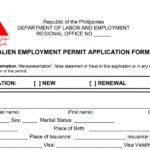
Hiring foreign employees in the Philippines requires employers to follow specific legal procedures established under the Philippine Labor Code and Department of Labor and Employment (DOLE) regulations. Foreign nationals must obtain an Alien Employment Permit (AEP) from DOLE to demonstrate that no qualified Filipino worker is available for the position, followed by a 9(g) Pre-Arranged Employment Visa from the Bureau of Immigration (BI) for legal residency and work authorization. Employers hold primary responsibility for sponsorship, including labor market testing, skills transfer programs, and compliance with foreign-to-local employee ratios. The complete process typically requires 6 to 12 weeks and involves costs ranging from PHP 25,000 to PHP 50,000 per employee, excluding professional service fees.
Legal Framework Governing Foreign Employment
The Philippine legal system prioritizes employment opportunities for Filipino citizens, permitting the hiring of foreign employees only when specialized skills or qualifications are unavailable locally. Under Article 40 of the Labor Code and DOLE Department Order No. 248, employers must conduct a labor market test and implement skills transfer programs as conditions for approval. The dual authorization process involves DOLE for work permits (AEP) and BI for immigration status (9(g) visa), ensuring both labor market protection and lawful residency.
Key regulatory principles include:
- Labor Market Testing: Employers must advertise positions for 15-30 days on PhilJobNet and newspapers, documenting the absence of qualified local applicants.
- Employee Ratios: Restrictions limit the number of foreign workers relative to Filipino employees in most sectors.
- Skills Transfer: Mandatory understudy training programs require foreign employees to train Filipino counterparts within specified periods.
- Employer Liability: Sponsoring companies face fines up to PHP 500,000 and potential blacklisting for non-compliance or unauthorized employment.
These requirements reflect the government’s commitment to workforce development while allowing access to critical foreign expertise.
Step 1: Conduct Position Assessment and Explore Alternatives
Before initiating the formal process to hire foreign employees, employers should thoroughly assess whether Filipino candidates possess the required qualifications or if alternative hiring structures suffice. Direct employment through AEP and 9(g) visas suits permanent executive, technical, or specialized roles, while Employer of Record (EOR) services or independent contractor arrangements offer faster compliance for project-based or scaling needs.
Consider these alternatives:
- Employer of Record (EOR): A local entity employs the foreign worker on behalf of the hiring company, managing all DOLE and BI compliance without requiring company registration in the Philippines.
- Independent Contractor Model: Suitable for short-term, specialized projects where the relationship qualifies as genuine business-to-business under the four-fold test (selection, wages, dismissal power, control).
- Direct Employment: Required for long-term positions, involving full AEP and 9(g) processing.
Employers should document the business justification and skills gap analysis as foundational evidence for DOLE approval.
Step 2: Secure Alien Employment Permit (AEP) from DOLE
The Alien Employment Permit serves as the prerequisite work authorization, issued by DOLE after verifying the position’s necessity and absence of local talent. Employers must complete a 30-day labor market test, followed by formal application submission at the appropriate DOLE Regional Office.
Required documentation includes:
- Completed AEP application form with notarized employer certification.
- Proof of job vacancy publication on PhilJobNet and at least one newspaper of general circulation.
- Employment contract detailing position, salary (meeting minimum wage standards), duration, and responsibilities.
- Foreign employee’s curriculum vitae, educational qualifications, and professional licenses (apostilled if issued abroad).
- Company registration documents (SEC Certificate for corporations, DTI for sole proprietorships), latest financial statements, and organizational chart.
- Understudy Training Program (UTP) plan identifying Filipino trainees, training curriculum, duration (minimum 3 months), and evaluator.
- Filing fee of PHP 9,000 per year of validity.
DOLE processing typically requires 2-3 weeks for complete applications. Upon approval, employers may request a Provisional Work Permit to allow the employee to commence duties while the 9(g) visa processes.
Step 3: Petition for 9(g) Pre-Arranged Employment Visa at BI
With AEP secured, employers petition BI for the 9(g) visa, which grants legal residency and work rights typically valid for 1-3 years. The application involves a formal hearing, biometric capture, and ACR I-Card issuance.
Additional BI requirements encompass:
- Certification of current foreign and Filipino employee numbers, confirming ratio compliance.
- Joint request letter from the employer and the employee addressed to the BI Commissioner.
- Employee’s medical certificate (BI Form 11), police clearance (apostilled), and a valid passport.
- Company tax clearance and proof of remittance for employee withholding taxes.
- Visa fees ranging from PHP 10,130 (1-year, non-Top 1,000 corporations) to PHP 24,210 (3-year), plus ACR I-Card fees of USD 50-150.
The BI hearing verifies documentation authenticity, after which approved petitions proceed to biometrics and card printing (1-2 weeks). Regional BI offices handle applications outside Metro Manila.
Complete Cost Structure for Hiring Foreign Employees
The financial commitment to hire foreign employees includes permit fees, visa charges, and ancillary costs, totaling PHP 25,000-PHP 50,000 initially, with annual renewals at approximately 50% of the initial amounts.
Detailed breakdown:
| Category | Cost Range (PHP) | Notes |
| AEP (DOLE) | 9,000 per year | Non-refundable; per position |
| 9(g) Visa (BI Principal) | 10,130-24,210 (1-3 years) | Varies by company size/validity |
| ACR I-Card | USD 50-150 | Matches visa duration |
| Medical/Police Clearances | 5,000-10,000 | Employee responsibility |
| Notarization/Apostille | 3,000-7,000 | Foreign documents |
| Total Initial | 25,000-50,000 | Excludes legal/professional fees |
Top 1,000 corporations and PEZA-registered firms qualify for reduced BI fees. All payments occur via Order of Payment Slip at authorized banks.
Processing Timelines from Assessment to Onboarding
The end-to-end timeline to hire foreign employees spans 6-12 weeks, contingent on preparation quality and agency workload. Parallel processing of documentation accelerates completion.
Stage-by-stage duration:
| Process Stage | Typical Duration | Cumulative Timeline |
| Position Assessment | 1 week | 1 week |
| Labor Market Test | 30 days | 4-5 weeks |
| AEP Processing | 2-3 weeks | 6-8 weeks |
| 9(g) Visa & ACR | 3-5 weeks | 9-13 weeks |
| Onboarding/Registration | 1 week | 10-14 weeks |
Provisional Work Permits enable employment during the BI phase, minimizing downtime.
Ongoing Compliance After Successful Hiring
Post-approval obligations ensure continued authorization when hiring foreign employees. Employers must monitor multiple renewal cadences and reporting requirements.
Annual responsibilities include:
- AEP Renewal: File 60 days before expiry with updated understudy reports.
- 9(g) Visa Extension: Submit 30 days prior, matching AEP validity.
- BI Annual Report: Foreign employees report January-March with ACR I-Card.
- Understudy Training: Complete and certify skills transfer within the mandated period.
- Ratio Monitoring: Maintain foreign-to-local employee limits.
Non-compliance risks revocation, fines up to PHP 500,000, and deportation orders. BI audits verify ongoing job necessity.
Alternative Models: EOR and Independent Contractor Arrangements
Direct hiring represents one pathway to hire foreign employees; alternatives provide flexibility for specific scenarios. Employer of Record services employ workers through a local entity, handling all compliance while granting operational control to the client company. Independent contractor relationships suit short-term projects but carry misclassification risks under the four-fold test.
EOR advantages include immediate onboarding without AEP/visa processing, full Labor Code compliance (SSS, PhilHealth, 13th-month pay), and scalability. Contractors require careful contract drafting to avoid reclassification as employees, triggering retroactive liabilities.
Common Compliance Challenges and Risk Mitigation
Employers frequently encounter pitfalls when attempting to hire foreign employees, including labor market test failures, ratio violations, and incomplete understudy programs. Mitigation strategies involve pre-application audits, legal review of employment contracts, and third-party compliance monitoring. Documentation retention for three years supports audit defense.
Final Thoughts
The process of hiring foreign employees in the Philippines requires rigorous adherence to DOLE AEP requirements, BI 9(g) visa procedures, and ongoing compliance obligations that span 6-12 weeks, with costs of exceeding PHP 25,000. EOR and contractor models offer viable alternatives for operational flexibility. Work Visa Philippines delivers comprehensive guidance, ensuring legal compliance and operational efficiency for 2026 business growth.
Is Assistance Available?
Yes. Work Visa Philippines provides end-to-end support for companies seeking to hire foreign employees, managing AEP petitions, 9(g) visa processing, EOR arrangements, and ongoing compliance. Services eliminate procedural errors and align with 2026 regulatory updates for seamless workforce expansion.
Contact our team of specialists for expert guidance:
- Contact Us Here
- Fill Out the Form Below
- Call us at +63 (02) 8540-9623