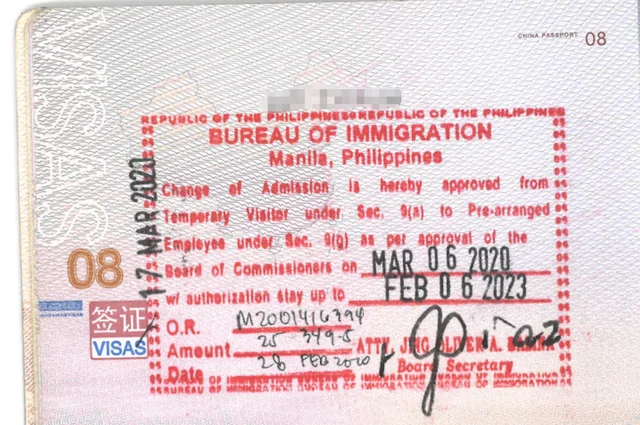
The Bureau of Immigration (BI) has issued updated internal guidelines on the 9G visa issuance process, clarifying timelines, documentation, and eligibility criteria for foreign nationals seeking to work in the Philippines. The 9(g) Pre‑Arranged Employment (Commercial) Visa remains the primary work‑based visa for foreign nationals employed by Philippine‑registered companies, and its issuance is now more tightly coordinated with DOLE‑issued Alien Employment Permits (AEPs) and BI‑linked compliance obligations.
For corporate HR and immigration practitioners, understanding the latest 9G visa issuance framework is essential to avoid rejections, delays, or irregularities in the employment immigration pipeline.
What the 9G Visa Is and Why It Matters
The 9G visa is a non‑immigrant, work‑specific visa that allows a foreign national to legally work for a Philippine employer while residing in the country. It is issued under IATF Resolution No. 131‑A and is commonly described as a Pre‑Arranged Employment (Commercial) Visa for employees of corporations, partnerships, or sole proprietors doing business in the Philippines. The 9G visa is not a standalone permit; it builds on the Alien Employment Permit (AEP) issued by the Department of Labor and Employment (DOLE), which first authorizes the employer to hire a foreign national. Together, the AEP and the 9G visa form the legal foundation for bringing international talent into the Philippine labor market.
Key 2026 Guidelines on 9G Visa Issuance
The BI’s 2026 internal guidance on 9G visa issuance highlights several operational clarifications that affect the way employers and employees approach the process. These guidelines emphasize:
- AEP-centric processing: The BI closely links the 9G visa application to the validity, scope, and compliance status of the AEP, treating the AEP as the primary labor‑market clearance.
- Strict documentation standards: BI officers are instructed to verify that all required documents are complete, notarized, and aligned across the AEP, employment contract, and 9G visa petition.
- Biometric and ACR-I Card integration: The 9G issuance process incorporates mandatory biometric capture and issuance or registration of the Alien Certificate of Registration Identity Card (ACR I‑Card) for applicants aged 11 and above.
- Timeliness and compliance tracking: The BI tracks the completeness of the 9G application through its internal checklist system and expects applicants or employers to use the BI e‑Services portal to monitor status and respond promptly to requests for additional information.
Employers and HR teams must therefore treat the 9G visa issuance not as a one‑off filing but as a continuous, document‑driven lifecycle that begins with the AEP and continues through ACR‑I Card issuance and renewal.
Who Is Eligible for 9G Visa Issuance?
The BI guidelines reiterate the basic eligibility criteria for foreign nationals seeking a 9G visa issuance. Key conditions include:
- The applicant must be a foreign national lawfully present in the Philippines, typically on a 9(a) tourist‑visitor status or another valid non‑immigrant visa.
- The applicant must hold an approved AEP issued by a DOLE regional office, showing that the role cannot be filled by a qualified Filipino and that the employer has met the Economic Needs Test (ENT) requirements.
- The applicant must have a valid employment contract with a Philippine‑registered employer that matches the job title, duties, and salary stated in the AEP and the 9G visa petition.
- The applicant must have no criminal record or derogatory immigration record in the Philippines or abroad, and must clear basic law‑enforcement checks such as the BI Clearance Certificate and, where applicable, NBI or equivalent foreign police clearance.
The BI also expects that the applicant is not engaging in illegal employment and that the company hiring the foreign national is a legally registered entity under the Securities and Exchange Commission (SEC) or the Department of Trade and Industry (DTI) and holds the necessary local permits.
Required Documents for 9G Visa Issuance
The 9G visa issuance process is driven by a detailed checklist published by the BI and updated under the IATF‑linked framework. The BI requires both employer‑submitted and employee‑submitted documents, which must be presented in the prescribed format.
Typical documents include:
- For the employer/petitioner:
- A duly accomplished Consolidated General Application Form (CGAF) for 9G visa issuance under IATF Resolution No. 131‑A (two copies).
- A notarized joint letter of request from the employer and petitioner explaining the need for the foreign hire and the company’s business context.
- Corporate documentation, such as the General Information Sheet (GIS), SEC registration, or DTI and Mayor’s Permit, depending on the company type.
- A notarized certification of the number of foreign and Filipino employees, which helps the BI verify compliance with the 60‑40 employment structure, where applicable.
- For the employee:
-
- A valid passport with at least six months of validity, plus photocopies of the bio‑page and current visa status.
- An Alien Employment Permit (AEP) issued by DOLE, accurately reflecting the job title, duties, and salary.
- A notarized employment contract or appointment letter, consistent with the AEP and CGAF.
- Police clearance from the applicant’s country of origin and, often, NBI clearance once in the Philippines.
- A BOQ medical clearance (Bureau of Quarantine) if applicable, as required by BI‑linked Operations Orders.
- A BI Clearance Certificate confirming the applicant’s immigration history and absence of overstay or other violations.
For dependents (spouse and children) to be included under the 9G visa, the employer must file a separate CGAF for “Inclusion to 9G visa issuance,” supported by authenticated marriage and birth certificates and proof of filiation with the principal 9G‑holder. Incomplete or mismatched documents are the leading cause of delays or rejections in the 9G visa issuance process.
The 9G Visa Issuance Process
The BI’s 2026 guidelines describe a clear, multi‑stage workflow for 9G visa issuance at the BI Main Office or at an authorized BI office that handles 9G transactions.
- Pre-filing preparation: The employer secures the AEP from DOLE, then prepares the full 9G document kit, ensuring that the job title, duties, and salary match across the AEP, employment contract, and CGAF.
- Document pre-screening: The petitioner or the foreign national submits the documents to the Central Receiving Unit (CRU) or the frontline officer at a BI office; BI staff conducts a pre‑screening to check completeness and compliance with the checklist.
- Payment of fees: Once the documents pass pre‑screening, the BI issues an Order of Payment Slip (OPS), and the employer or employee pays the prescribed 9G visa fees and any express‑lane charges.
- Evaluation and hearing: The case is assigned to a Visa Officer, who may conduct a brief hearing or written evaluation to confirm eligibility, verify the employer’s capacity, and ensure that the foreign hire meets the job specification.
- Biometrics and ACR I-Card: The applicant attends the Alien Registration Division (ARD) for biometric capture and ACR I‑Card application, submitting the required photos and documents.
- Visa stamping and release: After the Board of Commissioners or designated BI authority approves the 9G petition, the BI stamps the visa in the passport and returns the ACR I‑Card, which is often valid for the same period as the 9G visa (typically two to three years, subject to AEP and company‑status continuity).
Processing time can range from three to six weeks, depending on BI workload and the completeness of the submitted documents.
Monitoring 9G Visa Issuance Status
The BI instructs applicants and employers to monitor the status of the 9G visa issuance through the BI e‑Services portal or by checking the BI website’s “Visa Application Status” feature. If the BI requests additional information, clarification, or documents, the petitioner must respond promptly to avoid being dropped from the processing queue.
The 9G visa issuance status is typically updated in stages such as “For Evaluation,” “Under Review by the Board,” and “Approved/Released,” enabling employers to plan project timelines, travel, and onboarding around the expected visa‑approval date.
Compliance Obligations After 9G Visa Issuance
The BI’s 9G guidelines emphasize that visa issuance does not end the compliance journey; employers and employees must maintain ongoing immigration obligations. These include:
- ACR I-Card renewal and biometrics: The applicant must renew the ACR I‑Card when it expires and undergo biometric capture every few years, as mandated by BI circulars.
- Annual Report (AR): The foreign national must file the Annual Report with the BI every January–March, confirming that the visa and ACR I‑Card remain valid and that the person is still in the Philippines.
- Employment and status changes: If the employee changes employers, job titles, or employers change their business structure or location, the BI must be notified promptly, and the 9G visa may need to be amended or downgraded to a different visa category.
Failure to meet these obligations can result in administrative sanctions, including the suspension of the 9G visa, fines, and, in extreme cases, deportation or blacklisting.
Wrapping Up
The 2026 BI guidelines for 9G visa issuance underscore the importance of strict document control, alignment between the AEP and the 9G visa, and continuous compliance with immigration obligations such as the ACR I‑Card and Annual Report. For foreign nationals and their employers, understanding this process is essential to secure a stable, lawful work status in the Philippines.
Ready to Streamline your 9G Visa Issuance Process?
Work Visa Philippines helps foreign employers and employees navigate the 9G visa issuance landscape, ensuring that AEP and 9G applications are filed correctly, monitored closely, and renewed proactively.
Reach out to our team of specialists to get the help you need:
- Contact Us Here
- Fill Out the Form Below
- Call us at +63 (02) 8540-9623