The 9D Treaty Trader/Investor Visa is a specialized non‑immigrant visa available exclusively to nationals of countries with which the Philippines maintains bilateral treaties of commerce and navigation. Currently limited to the United States, Japan, and Germany, this visa allows eligible nationals to enter, reside, and engage in substantial trade or investment activities between their home country and the Philippines. For foreign nationals from these treaty countries—often searching for information under the keyword “treaty investor visa”—the 9D visa offers a streamlined pathway to manage cross‑border business operations, develop enterprises, and supervise investment projects without requiring a standard 9(g) employment visa or Alien Employment Permit (AEP).
Which Countries Qualify for the Treaty Investor Visa?
The 9D visa is predicated on reciprocal treaty relationships between the Philippines and a limited number of trading partners. As of 2026, the three treaty countries eligible for the 9D visa are:
- United States (under the Treaty of Commerce and Navigation between the United States and the Philippines)
- Japan (under the Treaty of Commerce, Navigation, and Reciprocity between Japan and the Philippines)
- Germany (under the Treaty of Friendship, Commerce, and Navigation between Germany and the Philippines)
Nationals of these countries—including citizens by birth, naturalization, or descent—may apply for the 9D visa as treaty traders or treaty investors, and it also extends to certain executive or supervisory employees of qualifying enterprises. The applicant must be of the same nationality as the majority shareholder of the sponsoring firm, ensuring that the treaty benefits flow to genuine treaty‑country nationals rather than third‑country proxies.
Other countries, even those with strong economic ties to the Philippines, are not eligible for the 9D visa and must pursue alternative pathways such as the 9(g) Pre‑Arranged Employment Visa or the Special Investor’s Resident Visa (SIRV).
Treaty Trader vs. Treaty Investor: Key Differences
The 9D visa encompasses two distinct but related activities: treaty trading and treaty investing, each with its own evidentiary requirements.
Treaty Trader activities involve substantial trade (import/export) between the Philippines and the treaty country, where the applicant:
- Carries on substantial trade principally between the Philippines and its treaty country (e.g., importing Japanese machinery to the Philippines for resale or exporting Philippine agricultural products to Japan).
- Engages in trade that is substantial—typically measured by volume, frequency, and financial scale—and continuous rather than isolated or speculative transactions.
- May be an owner, partner, or employee of a trading enterprise, provided they are actively developing and directing the trade operations.
Treaty Investor activities focus on developing and directing an enterprise in which the applicant has invested a substantial amount of capital (often cited as USD 120,000 minimum, though BI evaluates on a case‑by‑case basis). The investor must:
- Invest substantial capital in a bona fide enterprise (non‑nationalized business) in the Philippines.
- Be coming to develop and direct the operations of that enterprise, typically as an owner, executive, or supervisor.
- Ensure the investment is at risk (subject to loss if the enterprise fails) and is active rather than passive or speculative.
Both categories require proof of substantiality—financial scale, continuity, and economic contribution—making the 9D visa suitable for serious cross‑border business operators rather than casual traders or small‑scale investors.
Eligibility Requirements for the 9D Visa
Beyond treaty country nationality, the BI evaluates 9D visa applicants based on substantial trade/investment, active management, and good standing. Core requirements include:
- Proof of nationality: Valid passport from the United States, Japan, or Germany, with supporting documents such as a birth certificate or naturalization papers if needed.
- Evidence of substantial trade or investment: For traders, contracts, invoices, shipping documents, and financial statements showing continuous trade volume; for investors, proof of capital infusion (e.g., inward remittance receipts, bank statements, SEC registration, or investment certificates) demonstrating at least USD 120,000 in a qualifying enterprise.
- Active role in the enterprise: The applicant must demonstrate they will develop and direct operations, typically as an owner, executive, supervisor, or essential specialist employee of the same nationality as the majority shareholder.
- Good moral character and health: No derogatory immigration record, criminal convictions, or communicable diseases, supported by police clearances and medical certificates.
- Employer sponsorship (if applicable): For employees of a treaty enterprise, a letter from the sponsoring firm confirming the role, salary, and treaty‑based ownership structure.
The BI conducts a substance‑over‑form review to ensure that the trade or investment is genuine and not a visa sham, rejecting applications that appear marginal, speculative, or lacking continuity.
Application Process for the Treaty Investor Visa
The 9D visa application is typically filed at a Philippine embassy or consulate abroad for entry clearance, or, for those already in the Philippines on a 9(a) visa, at the BI Main Office for conversion or extension. The process includes:
- Pre‑application preparation: Gather proof of nationality, trade/investment evidence, business registration documents (e.g., SEC Certificate of Incorporation, Articles of Incorporation), and personal clearances.
- Submission of documents: Complete the 9D visa application form, submit a joint letter of request (from the applicant and sponsor if applicable), and pay the visa fees at the embassy or BI office.
- Interview and verification: The consular officer or BI evaluates the substantiality of the trade/investment, the applicant’s role, and compliance with treaty terms; additional documents may be requested.
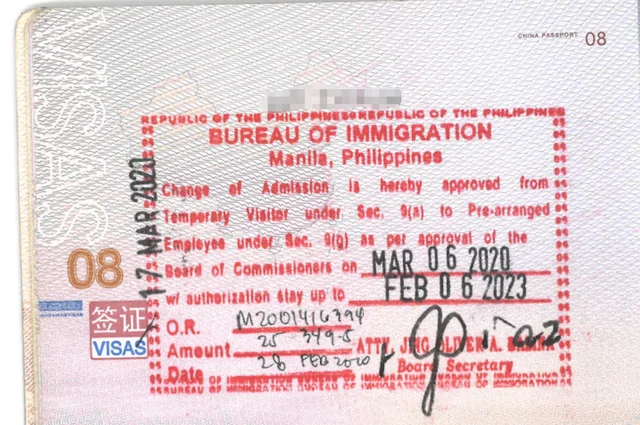
- Visa issuance: If approved, the 9D visa is stamped in the passport, typically valid for two years with multiple‑entry privileges, renewable upon proof of continued qualifying activity.
Processing time varies from one to four weeks, depending on the embassy/BI workload and the completeness of the application.
Benefits and Privileges of the 9D Visa
The treaty investor visa offers unique advantages over standard work visas:
- No AEP required: Unlike the 9(g) visa, the 9D does not need a DOLE Alien Employment Permit, as treaty status supersedes standard labor‑market testing.
- Multiple entry and long-term stay: Holders enjoy multiple‑entry privileges and can renew the visa for as long as the treaty trade/investment continues.
- Dependent inclusion: Spouses and unmarried children under 21 can be included or derive dependent status, allowing family accompaniment.
- Flexibility for executives and employees: Covers owners, executives, supervisors, and specialist employees of the same nationality as the majority shareholder.
- Streamlined renewals: Renewals focus on proof of continued substantial activity rather than full re‑application.
These benefits make the 9D visa particularly attractive for U.S., Japanese, and German nationals managing cross‑border trade or greenfield investments in the Philippines.
Renewal and Compliance for 9D Visa Holders
The 9D visa is renewable, but holders must demonstrate continued substantial trade or investment activity at renewal time. Key compliance steps include:
- Filing renewals before expiration, with updated financial statements, trade records, or investment proofs showing ongoing operations.
- Maintaining the ACR I‑Card (Alien Certificate of Registration Identity Card) and filing the Annual Report (AR) every January-March.
- Ensuring the enterprise remains active and compliant with SEC, tax, and business permit rules; dormant or failed investments may lead to non‑renewal.
Non‑compliance, such as abandoning the trade/investment or engaging in unrelated work, can result in visa cancellation and potential blacklisting.
Key Takeaways
The treaty investor visa (9D) offers U.S., Japanese, and German nationals a privileged, streamlined pathway to engage in substantial trade or investment in the Philippines, bypassing many of the standard AEP and 9(g) requirements. With proof of nationality, substantial activity, and active management, eligible applicants can secure multiple‑entry residence and work rights tied to their treaty‑based enterprise.
Get Expert Assistance
Work Visa Philippines guides treaty traders and investors through the 9D visa process, from eligibility verification to renewal compliance, ensuring seamless market entry.
Are you from the U.S., Japan, or Germany and ready to trade or invest in the Philippines? Contact our team today:
- Contact Us Here
- Fill Out the Form Below
- Call us at +63 (02) 8540-9623